
Bitcoin’s recent price crash towards $60,000 did more than just shave billions off market capitalizations or liquidate leveraged positions.
It served as a massive, chaotic stress test that exposed a widening behavioral fracture between the two most dominant venues in the digital asset economy.
On one side stands Coinbase, the largest US exchange, where Chief Executive Officer Brian Armstrong has painted a picture of stoic resilience among retail investors.
On the other hand lies Binance, the leading offshore venue, where on-chain data depict frenetic selling and risk aversion.
This divergence matters because it reframes the narrative for the weeks ahead.
Thus, Bitcoin’s drop to the $ 60,000s and subsequent rebound is not simply a tale of retail buying the dip.
Instead, it is a complex saga about which specific retail cohort, on which specific venue, actually sets the marginal price during a leverage-driven unwind.
As Bitcoin hovers near $70,000 again, the sustainability of the recovery depends entirely on whether US-linked spot demand can flip from a headwind to a tailwind fast enough to counter the selling pressure observed offshore.
The Coinbase fortress and the premium disconnect
The narrative emerging from Coinbase is one of conviction.
According to Armstrong, the platform’s retail customer base refused to capitulate even as prices tumbled. He noted that these investors have been “resilient,” actively adding to their Bitcoin and Ethereum holdings in native units rather than fleeing to cash.
Furthermore, Armstrong noted that these customers largely maintained their February balances at or above the levels observed in December.
In crypto culture, this is the classic “diamond hands” behavior as the small investors hold their nerve and accumulate assets when fear grips the broader market.
However, CryptoSlate’s analysis of on-chain data has identified a discrepancy between this account of retail resilience and the exchange’s actual pricing mechanics.
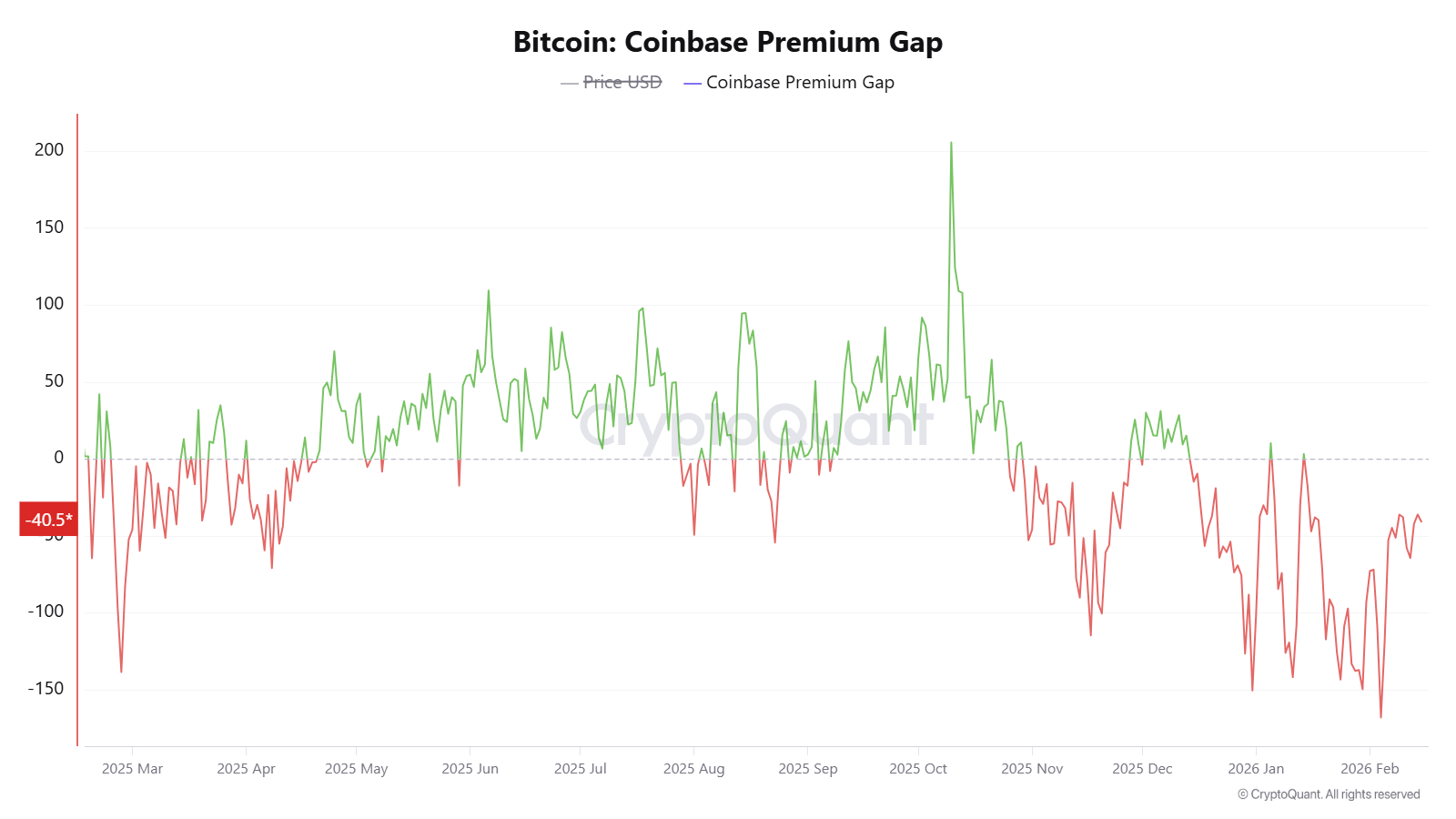
The Coinbase Premium Index, a metric provided by analytics firm CryptoQuant, tells a cooler story about US spot appetite.
This index is often used by traders to infer whether Coinbase is trading at a premium or discount relative to offshore venues.
For much of the recent correction, this indicator remained predominantly negative.
A sustained negative premium is typically interpreted as signaling softer US-linked spot aggression relative to the rest of the market.
While Armstrong’s observation about retail’s persistence may be accurate, the negative premium suggests that they were not the dominant force.
The reconciliation of these two viewpoints lies in the concept of the “marginal price-setter.”
Armstrong may be right about retail behavior within Coinbase, whereas the premium remains negative if the marginal buyer on Coinbase is not a retail user.
If retail’s net buying is incremental (akin to Dollar-Cost Averaging) and not large enough to overwhelm other forces, such as institutional de-risking, ETF outflows, arbitrage flows, or macro hedging, then the price will still tend to be lower.
Recently, CryptoQuant flagged a notable upward surge in the index. Although it remains below neutral, the rebound hints that US selling pressure may finally be easing.
The critical factor to watch is whether this shift is sustained. A brief blip does not change a market regime, but if the premium turns positive and stays there, it would imply that Coinbase-linked demand is back in the driver’s seat.
Binance selling was loud, and whales did not lead it
While Coinbase users held the line, the tape on Binance showed a very different character.
On-chain data showed a pronounced burst of selling concentrated on the exchange, driven primarily by recent buyers rather than long-term holders.
CryptoQuant’s breakdown of exchange inflows over the past month clearly illustrated this dynamic. Short-term holders averaged approximately 8,700 BTC per day on Binance during the volatile period.
In the context of exchange mechanics, large inflows are often a precursor to selling, as investors move assets from cold storage to trading venues to liquidate.
Crucially, the heaviest inflows came from entities categorized as “fish” and “sharks” (mid-sized holders), while inflows from “whales” were comparatively small.
This distinction is vital because it indicates that the crash was neither a coordinated whale distribution nor a breakdown in conviction among long-term holders. Instead, it showed recent participants reacting to price action.
Notably, trader commentary supports this view. Crypto trader Dom noted that Binance had effectively “dumped” about 7,000 BTC at market over a two-day period, while other venues exhibited more neutral flows.
This data point provides insight into where aggressive selling appeared to have the greatest impact. In this scenario, Binance served as the execution venue for broad de-risking rather than as the source of deeper systemic stress.
Price moves on the margin, and the margin is venue-specific
This is where the Coinbase and Binance “characters” become more than trivia.
Markets move on the margin. A steady base of holders can exist alongside a falling price if another cohort is forced to sell, or chooses to sell, with more urgency than the buyers are willing to absorb at that moment.
If Coinbase retail is holding and nibbling, why did the price slide so hard? Because it only takes one channel of outsized net selling to dominate price discovery, especially during thin liquidity.
Binance has the capacity to absorb that activity and also the reflexive role that comes with being a primary venue for global traders. When sellers choose it, the rest of the market often follows.
That establishes a clearer framework for what matters next, and the question becomes where the marginal demand is.
First, does US-linked spot demand return strongly enough to change the marginal bid? A sustained flip in the Coinbase Premium Index from negative to positive is one signal traders will watch, because it would suggest the marginal buyer is back on Coinbase-linked rails.
Second, does Binance cease to be the de-risking outlet? If short-term holder inflows and mid-sized entity selling fade, it implies that reactive supply has largely been spent. Markets can stabilize when sellers are exhausted, even before strong new demand arrives.
Third, do institutional flows stabilize? CoinShares has reported significant outflows from crypto investment products in recent weeks, a reminder that even if one retail cohort is steady, asset-manager and ETF or ETP flows can dominate at inflection points.
Fourth, do derivatives markets keep pricing downside? CryptoSlate has previously reported heavy downside hedging into late-February expiries, with attention focused on strikes well below spot.
Persistent demand for deep downside protection can act as a psychological ceiling on rallies until it rolls off or unwinds, because it reflects a market that is still paying to insure against another decline.
What next for Bitcoin?
Based on the interaction between Coinbase’s resilience and Binance’s selling, three scenarios have emerged for the next two to eight weeks.
The “bull case” sees a demand regime shift. In this scenario, Coinbase Premium turns positive and remains there as institutional outflows slow materially, and Binance selling subsides.
Here, the market transitions from “post-liquidation repair” to “spot-led recovery,” and rallies are more likely to stick rather than fade.
The “base case” involves choppy consolidation.
Here, retail traders hold, but the premium oscillates around neutral without breaking into a sustained positive regime.
At the same time, Binance inflows diminish, but macro remains uncertain, and institutions stay cautious.
As a result, BTC price action compresses into a range, whereas leverage rebuilds slowly. This is the kind of environment in which headlines appear dramatic, but net progress is limited.
The “bear case” envisions a second leg down. If the premium stays negative, flows remain weak, and downside hedging remains dominant, the market risks revisiting prior lows.
Without a returning marginal bid, rallies become opportunities for de-risking, and the narrative shifts from “healthy reset” to “deeper derisking.”
The post Binance traders are panic selling but HODLing on Coinbase — the $60,000 BTC stress test appeared first on CryptoSlate.