
Crypto wallets used to mean one thing: self-custody. Users held their keys, owned their assets, and stayed off the radar of traditional finance.
Phantom’s Mar. 17 no-action relief from the CFTC’s Market Participants Division rewrites that definition.
The letter allows Phantom to serve as the consumer interface for regulated derivatives without registering as an introducing broker, provided registered futures commission merchants, introducing brokers, and designated contract markets handle the actual customer relationships, custody, and clearing.
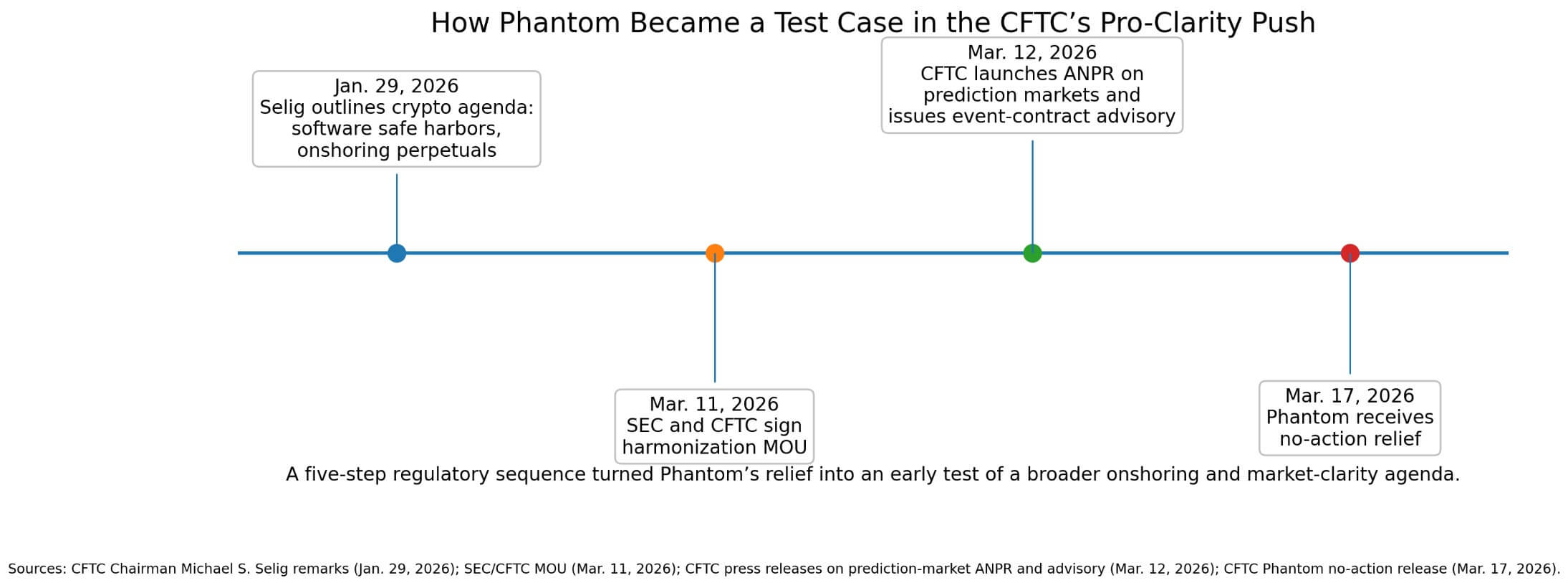
On Jan. 29, CFTC Chairman Michael Selig announced the agency would pursue “clear and unambiguous safe harbors for software developers” and explore onshoring perpetual derivatives.
On Mar. 11, the CFTC and the SEC signed a memorandum of understanding to harmonize oversight and reduce duplicative oversight.
One day later, the CFTC launched an advance notice of proposed rulemaking on prediction markets and issued a staff advisory on event contracts.
Five days later, Phantom received its relief. The sequence positions the letter as an early test case in a broader pro-clarity, pro-onshoring regulatory push.
Separation of interface and risk
The CFTC’s letter does something structurally novel by separating interface risk from market risk.
Phantom can display market data, aggregate positions, product information, and order entry for Commission-regulated derivatives. It can market those relationships, charge transaction-based fees to users, and receive revenue sharing from collaborators.
However, users must remain direct customers or members of the registered firms, their collateral stays with the designated clearing organization or FCM, and Phantom cannot take custody of customer assets, generate express buy or sell signals, or exercise routing discretion.
The wallet serves as the software layer, and the registered firm maintains the legal customer relationship and handles custody and clearing.
The regulator tolerates the split as long as the software stays passive and the guardrails stay strong.
Phantom must provide conflict and risk disclosures, follow communications rules as if it were an introducing broker, avoid certain promotional practices, maintain records, and enter written undertakings with collaborators that make Phantom and each collaborator jointly and severally liable for violations tied to the covered activities.
This arrangement exposes two competing theories.
The bull case holds that wallets become multi-product financial operating systems, bundling self-custody, payments, trading, and access to regulated markets into a single consumer experience.
Juniper Research projects global digital wallet users will rise from 4.4 billion in 2025 to more than 6 billion by 2030, with differentiation hinging on value-added capabilities and “superapp features.”
If the CFTC’s software-safe-harbor logic advances incrementally, wallets could compete with brokerages and exchange apps for retail trading distribution.
The bear case holds that Phantom stays a narrow one-off. Congress tightens event contract rules, state litigation fractures the market, and future Commission guidance declines to generalize the relief.
Democratic lawmakers introduced the BETS OFF Act on Mar. 17 to ban prediction market bets on military operations and other sensitive government actions.
The same day, Arizona filed criminal charges against Kalshi, arguing it ran an illegal gambling business despite Kalshi’s claim that federal commodities law preempts state gambling regulation.
The federal door may be opening while the surrounding politics grow more hostile.
The prediction market wedge
Prediction markets supply the most politically salient wedge for the wallet-superapp model, but the regulatory template extends beyond them.
The Phantom letter expressly covers event contracts, perpetual contracts, and other Commission-regulated derivatives.
FalconX’s February market note put 2025 prediction market volumes at $64 billion, said January 2026 alone reached $27 billion across tracked venues, and estimated the market could reach more than $325 billion in 2026.
In December, Kalshi raised $1 billion at an $11 billion valuation, with weekly trading volumes topping $1 billion, up more than 1,000% from 2024 levels.
In October, Robinhood’s event contract revenues were annualizing to more than $200 million.
As a result, mainstream financial infrastructure is responding.
On Mar. 10, Nasdaq and CME executives publicly called for clearer, durable rules as prediction markets draw retail traders and Wall Street interest.
ICE disclosed plans to invest up to $2 billion in Polymarket. CME launched a prediction markets platform with FanDuel in December.
The front-end distribution layer is becoming strategically valuable because the underlying market is big enough to support competitive positioning.
| Metric | Figure | Why it matters |
|---|---|---|
| 2025 prediction market volume | $64B | Shows the market is already meaningful |
| January 2026 tracked volume | $27B | Suggests accelerating near-term demand |
| FalconX 2026 projection | >$325B | Frames the growth case |
| Kalshi valuation | $11B | Shows investor confidence |
| Kalshi weekly trading volume | >$1B | Indicates live user activity |
| Robinhood event-contract revenue run rate | >$200M | Proves monetization in consumer finance UX |
| ICE planned Polymarket investment | Up to $2B | Confirms mainstream infrastructure interest |
The mechanics behind the model
The CFTC’s relief operates by requiring Phantom to act as a passive software layer connecting users to existing registered infrastructure.
The letter allows Phantom to show users what is available, where prices stand, and how to submit orders, while the actual regulated relationship sits with the FCM, introducing broker, or designated contract market on the other side.
Users trade on or through those registered collaborators, and their margin and collateral stay with the clearing or brokerage side. Phantom does not hold assets, does not route with discretion, and does not tell users what to buy or sell.
That passive interface logic allows the CFTC to extend regulated market access without requiring every software layer to become a full-stack intermediary.
The tradeoff is compliance burden. Phantom accepts disclosure, marketing, recordkeeping, and liability conditions similar to those imposed on regulated intermediaries.
The letter also says it reflects only the Market Participants Division’s views, does not bind the full Commission, may be modified or terminated, and remains in effect only until rulemaking or guidance supersedes it.
If this model generalizes, the next competitive edge in crypto moves from token issuance and protocol ownership toward consumer distribution, UX, and embedded compliance.
Wallets that can integrate regulated derivatives alongside self-custody and payments gain a structural advantage. The retail user experience changes: the wallet used for self-custody also becomes the place to access regulated event contracts or CFTC-supervised derivatives, without bouncing to a separate brokerage-style app.
Phantom says the relief applies to a custodial model with a registered exchange partner and does not cover DeFi derivatives or tokenized prediction markets.
Regulated finance is moving to crypto-native interfaces while staying on permissioned rails. The CFTC letter frames the model around users trading on or through registered venues and keeping margin and collateral with the regulated clearing and brokerage side.
| Function | Phantom wallet | Registered firms |
|---|---|---|
| Display market data | Yes | Yes |
| Show product information | Yes | Yes |
| Show aggregate positions | Yes | Yes |
| Accept order entry interface | Yes | Yes |
| Hold customer assets | No | Yes |
| Maintain customer relationship | No | Yes |
| Handle custody and clearing | No | Yes |
| Exercise routing discretion | No | Yes |
| Generate explicit buy/sell signals | No | No / regulated activity |
| Provide margin / collateral venue | No | Yes |
| Bear compliance obligations | Limited but meaningful | Primary regulated responsibility |
Constraints that define the outcome
The letter’s narrow, conditional, staff-level nature limits how far this can go.
A strong federal preemption win in court could accelerate wallet integrations. At the same time, a legislative crackdown on sensitive event contracts could narrow the most viral retail use cases and reduce the category’s appeal just as wallets start building around it.
The CFTC’s simultaneous invitation to innovation and tightening of rules creates real tension. Federal regulators are opening a door while states and Congress argue over what should be allowed through it.
Wallets are being invited into a tightly contested, regulated market under strict conditions.
The next phase of crypto adoption may hinge on wallets’ ability to serve as software shells for regulated finance.
Phantom’s relief suggests the CFTC is willing to run that experiment, at least under controlled conditions.
The regulators sketched the path. The market will decide whether anyone walks it.
The post Regulatory red tape ripped away from crypto wallets, granting direct access to derivatives appeared first on CryptoSlate.